
Retaining Walls in Erie, CO
Expert retaining walls services in Erie and the greater Denver metro — call (720) 737-8308 for a free consultation.
Retaining Walls Services in Erie, Colorado
Erie's relatively flat lots occasionally require retaining walls to define landscaping zones, prevent soil migration from elevated planting beds, or create level parking pads on properties where drives slope toward the home. Blackpine Hardscapes builds Erie retaining walls in concrete block and natural boulder, with proper drainage details that account for Weld County's clay-dominant soils where water retention behind walls can build significant hydrostatic pressure.
At Blackpine Hardscapes, we bring over 20 years of Colorado hardscaping experience to every project in Erie. We understand Weld County's soil conditions, HOA requirements, and the climate challenges that affect every outdoor installation in this region. Every project is designed from scratch for your specific property, vision, and budget.
Get a Free QuoteRetaining Walls in Erie — What to Expect
Our process covers every detail so your project in Erie is stress-free from design through installation.
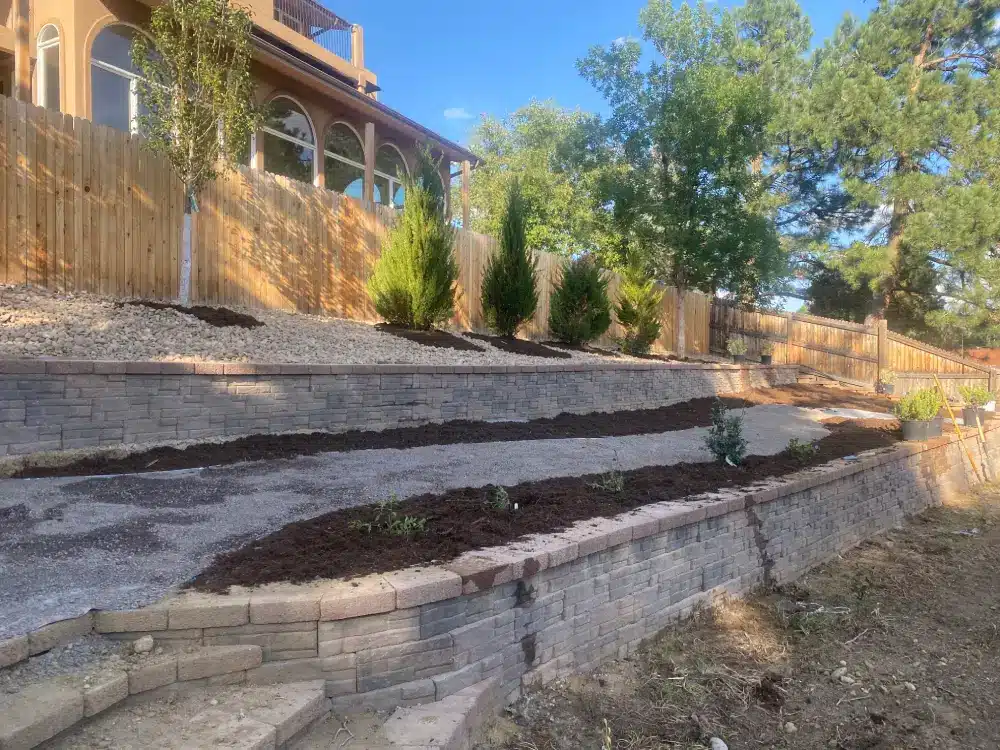
Why retaining walls fail in Colorado
Most retaining wall failures in Aurora trace back to the same problem: no drainage. Colorado's clay soils absorb and hold water. When that water freezes behind a wall in winter, it expands with enough pressure to push a properly built wall several inches out of alignment within two or three seasons. A wall without drainage is not built correctly for Colorado conditions, regardless of what material was used.
We build drainage into every retaining wall as standard, not an upgrade. That means excavating a drainage pocket behind the wall, filling it with clean crushed stone, running a perforated drain pipe at the footing to carry water away from the wall, and placing filter fabric between the gravel and native soil to keep clay from migrating into and clogging the drainage layer over time.
Footing depth is the other variable. Aurora's frost depth is 36–42 inches depending on location. Footings above that depth experience seasonal uplift that progressively works the wall out of plumb. Walls under 4 feet tall typically handle this with a continuous gravel base below frost depth. Walls over 4 feet need engineered designs with concrete footings down to frost depth, plus geogrid reinforcement embedded in the backfill at intervals specified by the engineer.
Retaining wall materials
Segmental concrete block — Allan Block, Versa-Lok, Anchor Diamond — is the most widely used retaining wall material on the Front Range. The interlocking system creates a battered wall face that uses gravity, and the design software lets engineers calculate exactly how much geogrid reinforcement a given wall height and surcharge load requires. Durable, repairable in sections, and available in a wide range of textures and colors.
Natural boulder walls use large granite, sandstone, or basalt stones placed by machine in a dry-stacked configuration. They self-drain through the gaps between stones, and they look like they belong in Colorado in a way that concrete block doesn't. The tradeoff is that large boulders need excavation equipment for placement, which affects access logistics and project cost.
Poured concrete walls are engineered structural elements, not masonry. They're used when space constraints prevent the setback needed for block systems, when loads are very high (driveways, parking areas overhead), or when a clean contemporary face aesthetic is the goal. They require stamped engineering drawings, rebar per specs, and proper form construction. They cost more and take more skill than block or boulder alternatives.
Height limits, permits, and what to expect on site
Walls up to 4 feet tall can generally be built in Aurora without engineering review, as long as they're not supporting a surcharge load like a driveway or building foundation. Walls over 4 feet need stamped engineering drawings and a building permit. Multi-tiered walls with two terraces close together may be treated as a single wall system even if no individual tier exceeds 4 feet, which can trigger engineering requirements.
HOA requirements layer on top of city permit requirements in many Aurora communities. Some HOAs restrict wall materials to specific block profiles or colors. Others require pre-approval for walls over certain heights or within specified distances from property lines. We review all applicable requirements before designing any retaining wall project.
Retaining wall excavations regularly turn up surprises: buried utilities that need protection, rock that requires specialized equipment, or utility easements that shift the wall location. We recommend a 10–15% contingency on retaining wall project budgets because subsurface conditions can't be fully assessed until the excavation is open.
Previous Projects.
Why Blackpine Hardscapes
Why Work With Blackpine Hardscapes in Erie?
We've been serving Erie and Weld County homeowners for over 20 years. Here's what that experience looks like on your project.
- Free 3D design consultation before any commitment
- Family-owned and operated — Jose leads every job
- Licensed, insured, and fully compliant with Colorado and Weld County standards
- Premium weather-resistant materials built for Colorado's climate
- Bilingual team — hablamos español
- Transparent pricing — no hidden fees, no surprise change orders
What Our Customers Say
"Highly recommend Blackpine for your landscaping needs. We had a concrete patio poured, landscape rock put in, and sod installed — completed in just one week with high quality work. Jose was a pleasure to work with, great communication, fair pricing, and a great crew."
— Jake
Retaining Walls in Erie — Frequently Asked Questions
What type of retaining wall is best for Colorado?
For Colorado's freeze-thaw climate and clay soils, segmental concrete block (Allan Block, Versa-Lok) is the most durable choice for walls under 4 feet. Natural stone walls offer timeless aesthetics. Poured concrete or timber walls are also options. All walls over 4 feet require engineering and a building permit in Colorado.
How much does a retaining wall cost in Aurora CO?
Segmental block retaining walls in the Denver metro run $35–$65 per sq ft of wall face. A 4-foot-tall, 20-foot-long wall (80 sq ft face) runs $2,800–$5,200. Natural stone walls run $50–$85 per sq ft. Walls requiring engineering or drainage systems add 15–30% to material costs.
How deep do retaining wall footings need to be in Colorado?
In Aurora and the Denver metro (frost depth 36–42 inches), retaining wall footings must extend below the frost line to prevent heaving. This is critical — walls with shallow footings shift and fail within 2–3 winters in Colorado. Our walls are always designed and built to the correct frost depth for your specific location.
Do retaining walls need drainage in Colorado?
Yes, drainage is critical. Colorado's clay soils retain water, and freeze-thaw cycles create enormous hydrostatic pressure behind walls. Every retaining wall we build includes a compacted gravel backfill zone, drainage fabric, and perforated drain pipe at the footing. Walls without drainage fail prematurely — often within 5 years.